Showing posts with label Dirndl. Show all posts

Friday, October 14, 2016

Vibrant Freising, 1000 Year Old Beer


Freising is a vibrant and energetic town with a population size of about 45,000. The city is full of cute shops and restaurants. There are several "Tracht" shops, which are clothing shops that especially feature traditional garments, like lederhosen and dirndls. There are numerous restaurants, cafes and coffee shops with outdoor seating, where you can sit with a cappuccino or espresso and watch the throngs of pedestrians and bikers move past. While the streets are open for automobiles, you see more people getting around on foot or bicycle, and there are large bicycle parking lots all over town.


Weihenstephan Brewery
One of the major attractions in the city is the Weihenstephan brewery. Weihenstephan is the world's oldest continuously operating brewery. That's right...the oldest brewery in the world. Most likely in the whole solar system. Without any evidence to back me up, I am going to go out on a limb and say that in the entire Milky Way, this is the oldest brewery. Weihenstephan brewed its first batch in the year 1040 (Okay, the Milky Way is a LOT older than that, so there are probably older breweries out there somewhere, and I would like to find them). The brewery grew out of a monastery that was founded by the patron saint of the city, St. Korbinian. Korbinian started the city of Freising as a school, church and monastery. The brewery gives a fascinating tour, but be sure to call a few months in advance to reserve one. They make several varieties of beer and export them all over the world. 976 years is a long time. It is sobering to think about all the nations that have risen and fallen in that time and they keep making beer. If it is too sobering for you to think about that, then crack open a Weihenstephaner Hefe Weisse Bier. I sampled 6 of their beers, and it was my favorite. It would be really cool to go there for their millennial celebration in 2040. It would be even cooler to be there for their bimillennial celebration in 3040, and a goal I will shoot for. The only disappointment was that they are no longer selling bottles of their original batch.


Any institution that exists for 1000 years is bound to have an impact on the community. A university grew up around the brewery and is a well respected science college. Weihenstephan-Triesdorf University offers a variety of science degrees, including of course, a degree in brewing. They also specialize in green engineering, not surprising, since Germany is constantly making strides in renewable energy, recycling, and reducing their carbon foot print. I've been watching them over the past few years as they have increased their percentage of renewable energy, and they are mostly renewable at this point. They are huge on recycling. We need to learn from the Germans before we destroy the planet.

Surrounding the Brewery and the University are beautiful gardens with fountains and benches.  The gardens are constantly maintained and full of a wide variety of flowers and trees. The brewery, university and gardens are located on the top of a high hill overlooking the city.  One of the best views in Freising is from the top of that peaceful hill. You look over the city, the Upper Bavarian Plateau, and see the Alps in the distance. The place is quiet, tranquil, a perfect place for quiet conversation, a picnic, or meditation.


View of Freising from atop Weihenstephan Hill 


One of my favorite experience in Freising was the hotel we stayed at. The Bayerischer Hof gives excellent service. I had stayed there once before, a few years ago. I was so impressed with the service that I wanted this to be the first place I stayed for my honeymoon. I emailed them ahead of time to tell them that. The went all out on the decorations for us, which was a huge surprise.  They also gave us a  complimentary bottle of German wine. Their service is fantastic, with friendly and competent staff. And their breakfast buffet is fresh, local and delicious.


The kitchen with full menu at the Bayerischer Hof was also fantastic. I had dinner at the Bayerischer Hof three years ago. For the first time in my life, I had sauerkraut and actually liked it. I didn't just pretend I liked it because I am of German heritage. For that matter, the same is actually true of beer. The truth is, I never liked beer until I went to Germany three years ago, and had it at the Oktoberfest. And if that isn't enough, the sausages in Germany were dramatically better than American sausages. They were much less greasy and had a better flavor. When I experienced espresso in Germany three years ago, it was like falling in love with coffee for the first time. I changed the way I make coffee at home because of it.  I always hear people talk about going to Europe and making grandiose statements that one thing or another is better over there than it is here. They sound a bit enamored. You hear and wonder if these things can really be better over there. We have the same exact thing here, right.  Your mind looks for explanations. Maybe its just that they were on vacation and had a nice trip. They were relaxed. They were sprinkled with fairy dust. It was spells cast by gypsies. Anything to try to rationalize.  But no, it is not grandiose. These things really are better over there. The sausages, the coffee, the sauerkraut, the beer … its not fairy dust, hallucinogenics or transcendental meditation.  These things really are better in Germany. Better quality ingredients and better preparation result in superior products. The pork roast and sauerkraut at Bayerischer Hof was an eye opening experience. The meat melted in my mouth. It was so tender I didn’t need a fork, I could have just used a straw. The pork roast really was outstanding and it changed the way I looked at sauerkraut.

The staff is friendly and professional the food is fantastic, and the location is perfect. If you want to spend some time in Freising, I strongly recommend Bayerischer Hof. Its only a twenty minute walk from the hotel to the brewery, university and gardens. The hotel is in the middle of town, you can spend several days walking around and exploring.


Wednesday, September 21, 2016

Oktoberfest 2016 - To Dirndle or Not to Dirndl?


Calling the Oktoberfest a beer festival is like saying  Shakespeare was a guy that made up stories. Sure you are right, but you would seriously be understating the depth, history and culture involved. You are missing the history, the other cultural aspects, and the heartfelt fun. German word of the day: "Herzliche Wilkomen" … it literally means heartfelt welcome. I have travelled around the world, and Germans are truly some of the friendliest and most optimistic people I have every met. I think anyone who has any interest in German history and culture ought to go the Oktoberfest in Munich at least once.


The Oktoberfest was originally a wedding reception for king Bavaria in 1810. He married Therese and threw a big party, inviting the local townsfolk. Ludwig and Therese were so well loved by the town folk, that the next year, they wanted an annual do-over. Or at least the party and the beer were well loved. It became an annual event. Years later, it evolved into a beer competition and hence a festival. "Wiesen" is the German word for field. The locals do not call it the Oktoberfest, they call it Thereseweisen;" Theresa's field.  Thus, the original party was basically a kegger in the field for the king and his new bride. I went to a couple keggers in high school. That's all I have to say about high school keggers. Not because I lack an opinion, just because I don’t remember anything about the keggers in high school.


Parade of drummers


been to Wiesen twice now. The atmosphere is fun-loving and easy-going, with drinking, dancing, music, good food, and open hearted people. Many times I have been lost and confused in Germany, and a local has come up to me volunteering their help. I grew up hearing about how friendly Canadians are, and have seen this reputation to be true, but they do not have Germans beat on this. Germans love to have fun. The serious, humorless German stereotype is unfounded. Walk into a beer tent and instantly start having fun with  900 other people. I learned the hard way not to stand in front of the door to the bar.  Bar maids carrying 12 large beer glasses at a time come rushing out of there in a near run. The Germans could have been yelling at me and calling me names, instead they only gently but firmly pulled me out of the way, preventing serious beer loss, injuries and humiliation. Well, probably the beer loss was the main motivation, but they were kind and jovial about it. The same thing is true with the kitchen door, and large trays of roasted chicken and vegetables.  Sometimes I learn the hard way.  German word of the day "Freundlich."  It means friendly, not lick your friends.  I might have learned that the hard way, too, I'm not saying.


Beer tents. Fun places with a terribly inaccurate name. They are far from actually being tents. These are large permanent wooden structures, about three stories high that seat about 9,000 people. If this is what you call a tent, I would not want to camp with you if I have to help you pitch it. Each tent has a complete kitchen serving delicious German food, and of course, beer. Lots of beer. Served in large glasses that hold about three bottles. Waiters and waitresses carry up to twelve of these at a time, a very cool sight to see. In the center of the hall, full of 9,000 patrons, you will find a band on an elevated stage, about half a floor into the air, suspended over the crowd. Horns, accordions, drums, singers, all playing traditional German music. The music is loud and energetic. Even without understanding the words, and not having any alcohol in me yet, I felt like dancing. Of the 9,000 patrons, you will find at least 100 dancing on tables at any one time (often much more than that).  It is all brightly lit, colorful and festive. The moment you walk in, you feel is an unmistakable air of light-hearted fun.


There are 14 large tents at the Wiesen, all matching the description above. The tents are owned by the breweries. So the Löwenbräu tent, of course, serves Lowenbrau, and so on. The other beer companies that have tents there are Paulaner, Augustiner, Spaten, Hofbräu and Hacker-Pschorr. About 7 million liters of beer are drunk by the end of the festival. Each tent will have specific bands contracted to play for them. The tents have different food offerings. One has fish on a stick (entire fish, roasted, on a stick). One has numerous roasted meats; duck, chicken, all sorts of beef and pork. One has crossbow competitions. What can go wrong with beer and crossbows in a large crowd, after all?

There are also much smaller tents which are quieter and do not specialize in beer or have bands. We spent time in a wine tent. If it were located anywhere else, the wine tent would not be called a "tent." It would be called a cute little restaurant. In German we would say the restaurant is "Gemütlich" which does not have a literal translation in English, but would mean it is very pleasing, comfortable and friendly, and you feel quite relaxed and at home. 
One of the smaller beer tents.. specializing in Fish on a Stick...and beer


There are also coffee, donuts, and pastry tents. It's not all about beer at the Oktoberfest; just mostly about beer.  There are also plenty of outdoor food and drink stands. The Oktoberfest also has a large midway, with roller coasters and other rides, carnival games, music. German word of the day: Fahrt"  It means to drive. So the roller coaster called "Fahrt zur Holle" is the drive through hell, not what It sounds like in English. 

Fahrt Zur Holle


Most Oktoberfest participants wear lederhosen or dirndls. You don’t have to wear the traditional clothing; you can wear jeans and t-shirts, but you will feel more like part of the event if you dress accordingly. You don't have to be German to wear the traditional outfits, the Germans will not be offended if you are from another country and still dress for the festival. 

I speak a little bit German, and I am nowhere near fluent. If you want to speak German to me, speak slowly and as if to a 4 year old, and we will do fine in conversation (until I cry). However, I rarely run into a German who is not fluent in English, and as soon as they hear my accent, they begin talking to me in perfect English. The downside to this is I don’t get a chance to practice my German, the upside is that we can communicate better, with more precision and expediency. The only time I found communication difficult was in the beer tents; it is so very loud in there, and very crowded. If you go, I recommend reserving space ahead of time. This is a German festival, by and for Germans, after all, so the default language is German. So if your German skills are not very high, it is hard to converse in the tents. I did manage to have a nice conversation with a woman and her husband who sat next to me. She spoke very little English, but between the two of us we could yell a pleasant conversation She was a surgical nurse, and since I am a medical doctor, we had some things in common. If you learn a little before you go, you will find yourself picking up a lot more just by being a tourist. My wife did not know much to start with, and she picked up a little German every day. I had to tell her to put the little Germans back down, we were trying to avoid trouble. I've been to Germany before, and I am trying to avoid trouble with the law. German word of the day: Rathaus. A municipal building. i.e. where politicians work. You can figure out the word roots there.

I really enjoy the German language, although I don’t find it lyrically beautiful like I do Italian. There are plenty of German words incorporated into English.  Kaput is German for Broken. A "Kind" is a child, and "Kinder" is plural for children, Garten is garden. So you see where the word Kindergarten came from.  I am sure you have all heard the word "beer garden"  That is what my grandparents used to call bars. I never heard them say the word "bar," it was always  "beer garden." That's right you guessed it's where Germans grow beer. Pull tabs from cans and bottle cap are seeds to grow more beer. Overall, you don’t have to speak German to go the Oktoberfest, but it would help.

If you like beer, Germany, parties and music, you should go to the Oktoberfest in Munich at least once in your life. I would only add two caveats. If you do not like large, loud bustling crowds, you won't like the beer tents. The other is to reserve a table ahead of time online at www.oktoberfest.de. Finding a seat ahead of time is very difficult and requires a lot of luck and patience.

Wednesday, November 13, 2013

Passau

The southern Bavarian city of Passau was originally established as the Roman colony, Batavia, in the second century B.C. The only thing that is this old in America is the average age of a Republican, so walking around this gorgeous city was heady, astounding, sobering, almost an out-of-body dissociate exercise. Just think to how long people have thrived their, how humanity and civilization has continued on there, in that one place for two millennia. Over two thousand years, before Jesus was born, people were there, evolving culture and society. In that ancient city whose history is prehistorical, I shopped and ate in many buildings that were built in the 13 century. 


One of the most breath-taking things I saw in this nearly 2300 year old city was the St. Stephan’s Cathedral (just think—that church was there even before Jesus was born. No wait a minute.. never mind.) The interior of the church is Italian Baroque in style, replacing an ancient Gothic structure that was destroyed by fire in the seventeenth century. Passau has a rich church history. The St. Severinus monastery was established in Passau in the fifth century, and within two hundred years, the Passau Diocese had grown to become the largest diocese in the Holy Roman Empire. Currently, St. Stephen’s cathedral is the largest church downtown, and it is the church that my cousins, Martina and Florian, attend. The St. Stephen's Cathedral (Der Passauer Stephansdom) is in the the "Old City" (Die Altstadt) portion of town. The pipe organ at St. Stephen's has 17,774 pipes and 233 registers. It was the largest pipe organ in the world from 1924 until it was usurped in 1994 by the First Congregational Church, Los Angeles. You have heard that old joke about the guy streaking through the church, haven’t you? They caught him by the organ. Well at this church, that guy would be easy to catch. Its a really big organ. The one at the church, I mean.


Here are the various names of the church at different times in history


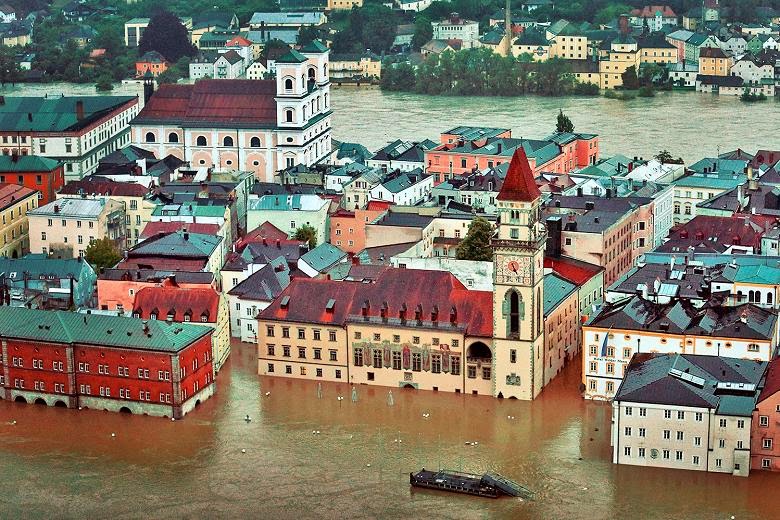
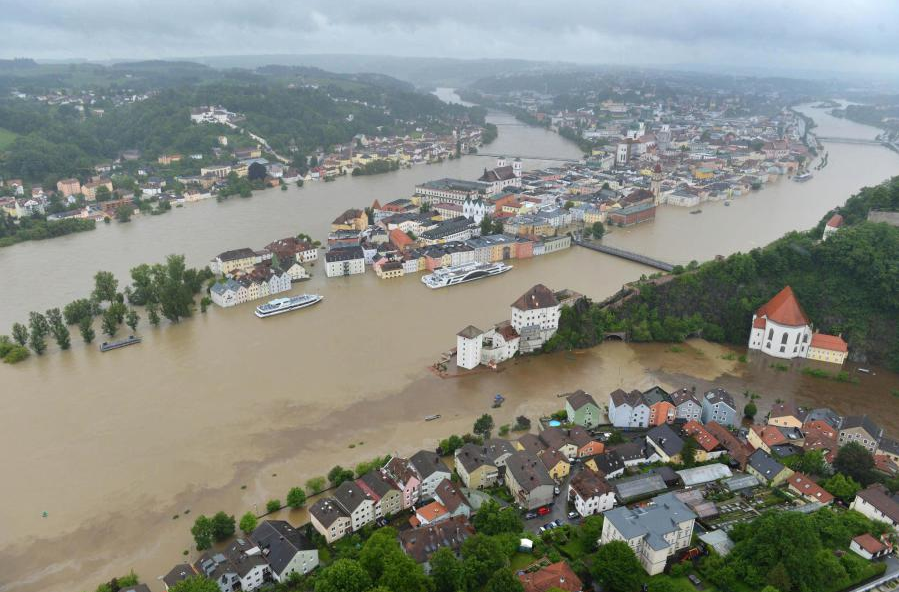
Passau was established on the confluence of three rivers; the largest and most well known is the Danube, the other two are the Inn River and the Ilz River. The downside to this natural aquatic beauty is the propensity to flood. As a matter of fact, in June 2013, they experienced the worst flooding in 500 years. One of the buildings next to the river has painted markings documenting the floods. What is hard to see in the photo is the most recent flood is pencilled in, not painted on the building yet; so I added that with Fotor. (Flooding pics are from the internet, since I was not there at the time; otherwise all pics from this post are from my iPhone. I do not own these pics and if the owner reads this and objects to my using them, I will remove them).


I had the great pleasure of meeting two of my distant cousins who live in Passau. A third generation American, my German connections have long been lost, and it is only by the magic of the Internet and Facebook that I have been able to reconnect with quiet a few of my German relatives. Martina and Florian are fun, intelligent, warm and exceptionally hospitable. Meeting them was phenomenal, and I am blessed to count them as friends and relatives. We had coffee and pie at the Konditerei Simon. After that, we had a great walking tour of the city, and my Bavarian cousins, both Passau natives gave me a city ... isn't that about the coolest thing in the world? How often in life do you get a personal tour of a foreign city by cousins you just met for the first time?  I have to say, this must surely be one of the highlights of my life.  I do look forward to the day when I can show them around Chicago.  After our walking tour, we ended the visit with coffee and a glass of wine at a amazingly charming cafe. We sat in the outside portion, in a courtyard in the center of the restaurant. We were surrounded by trellises with hanging plants. It was a cool fall evening in October, the air was fresh, the architecture surrounding us medieval Bavarian. The restaurant had thick fuzzy blankets to wrap up in while you enjoyed your hot beverage in the cool autumn air. 

 
This is the Kondieterie Simon, where I met my cousins


The city of Passau was breathtaking. It was never a surprise when I looked at a building and Martina would say “this was built in the 1200’s.” Amazing and awe-inspiring, but not a surprise. The centuries old building had a certain look and feeling to them, as if they have an aura themselves, speaking their own language about the centuries they have seen. The streets in the old part of town were cobblestoned and narrow, and overflowing with pedestrians. There were also many street vendors, entertainers and bicyclists. I saw people selling hot chestnuts, playing the French Horn, and putting on marionette shows. 


One of the things that I found particularly amusing on my Bavarian tour, is that there is an Irish pub every town. Being half Irish and half German, I found particular personal delight in this. Who doesn't like an Irish pub, after all? Us Irish are loads of fun ... and so are we Bavarians. Considering the two halves of my heritage, its no wonder I seldom take life too seriously. Particular amusing to me was this Irish Pub in Passau, right next to a lederhosen shop. I could buy my lederhosen and go right next door for a Guinness, and celebrate the totality of my heritage in one fell swoop. 


I could go back every year to Bavaria, and in particular, Passau. I hope to return with family and loved ones to share the experience.