Showing posts with label Cathedral. Show all posts

Monday, October 10, 2016

Freising Cold


Freising was a bit on the cold and rainy side while we where there, but it did not stop us from falling in love with the place! The worlds oldest brewery, legends and stories of saints, the city is rich and deep in history and heritage. It's not only cool because of its history, but the city today is vibrant, alive, energetic, and fun. Even late into the night, you will find people out and about, enjoying the town. One thing I have found consistently in my two trips to Germany, and having spend time in six different German cities, is that Germans are friendly and fun. I am most amazed about the German people. Germans are very friendly and happy. I love the mountains and cities and scenery, but most of all I love the people.

(It is pronounced "fry-zing," not "freezing." Regardless, whenever I say the name of the city, my wife tells me to get a jacket).


The city has its roots in the 8th century, established by a St. Korbinian. St Korbinian was named Waldegiso at birth. He was born in France.  His father died while Waldegiso/Korbinian was in infancy. He was then renamed by his mother, Corbiniana. Personally, I think Korbinian is a lot easier to say than Waldegiso, but I am not a medieval French dude, so I could be wrong. I do wonder, if after his name was changed, if they played a game of "Where's Waldegiso?"  They probably did, because he became a hermit monk for 14 years. He ended his hermacy with a trip to Rome. There the pope told him it was time to stop being a hermit, and go help develop the church in Germany. Korbinian/Where's Waldegiso stopped in what is now Freising, at a shrine to the Virgin Mary. He established a monastery, a school and a church, which became the core of Freising. The monks eventually began making beer, and when the monastery was disbanded, the brewery continued. It is the world's oldest continuously operating brewery, making beer since 1040.

On the way to Rome, legend has it, a bear killed Korbinian's pack horse. He was furious, and commanded the bear to carry his load the rest of the way to Rome. Commanding a bear to carry your luggage is pretty bad-ass, so the bear is the symbol of the city still to this day. I am surprised that Chuck Norris is not a saint.  Korbinian's bear is used as the symbol of Freising, and you will find painted statues of bears all over the city. The bear is also a part of Pope Benedict XVI's crest, due to his strong connection with the city. Then known as Joseph Ratzinger, he studied in Freising. He was ordained as a priest at St. Korbinian Cathedral in Freising. Father Ratzinger was later appointed Archbishop of Freising-Munich in March 1977. I was hoping that having a German pope would result in pretzel and beer communion, but apparently, he did not stay pope long enough to make it happen.


So naturally, my wife and I had to visit the Cathedral. It was beautiful, inside; mesmerizing and awe-inspiring. This is the Year of Mercy, as designated by Pope Francis; a year to focus on peace in the world. Several churches have been designated to have "holy doors" for the year, and you are supposed to enter them in prayer contemplating peace and humility. We reverently entered this door on the way in. The first church was built in 860 and rebuilt after a fire in 903. The church was completely destroyed by fire on Palm Sunday in 1159. Construction of the current Romanesque building started in 1159 and completed in 1205. The Romanesque wooden ceiling was replaced by a gothic vault in 1483.

Holy Doors at the Cathedral of Sts. Korbinian and Mary


Over time, several different small churches were built in the area. Later, these were all connected by building a large facility with connecting hallways, and all of these together comprise the Cathedral and current  Munich Diocese headquarters. So as we walked through the corridors of the cathedral, we entered various ancient churches and chapels that were once built separately and are now all connected.  There is a chapel to St. John of Nepomuk (I've never heard of him either, but the ancientness is kind of cool) that is now the Sacristy. There is a church of St. Benedict, and a church of St. John the Baptist. The basement has a crypt with the relics of three different saints, including the bones of St. Korbinian. It was a bit surreal, walking into a poorly lit basement. The displays were few and scattered, organized by any apparent logic. They were not well lit, and signage was obscure and esoteric. My German is far less than fluent, but I know enough to have a conversation with a four year old. There were not any 4 year olds to chat with in the crypts, so we studied the available sign, and felt immediately certain there were bones in these boxes, bones of saints. It took us about half an hour of google translator in a dark and isolated catacomb of an ancient church for us to realize we were standing in front of a crypt that held the remains of St. Korbinian himself. I'm just glad the bones of the bear were not around.

Crypt of Korbinian


Back up from the crypts, to the area of worship. The church was beautiful. The ceiling was filled with exquisite detail and endless frescoe paintings depicting heaven and other-world events. Some of the paintings in the church were done by Ruben. The Baroque and Renaissance paintings and frescos, sculptures are all breathtaking. Even the paintings not done by Ruben were very Rubenesque, which is better than being Picassoesque paintings in a church. Jesus with two eyes on the side of his nose would not be very reverent.

The church was one of the most beautiful places I saw that week in Germany, which says a lot, because we saw a lot of beautiful places.

There is so much more to say about Freising, I will conclude in another post. Freising is beautiful, peaceful, fun and cool. Cool, but not freezing. It is well worth the visit.

The rest of the photos are of the Cathedral and Diocese headquarters. It is a large complex.


Painting by Ruben 


Sunday, July 17, 2016

Bardstown Spiritually


Bardstown is charming city well worth the visit. Established around the time of the revolution, it boasts America's oldest stagecoach stop. It is a relaxing and enchanting place to spend an afternoon strolling about, visiting shops, restaurants and bars.  It is also, I discovered, a place to be greatly inspired and connect with God. This is one of the most well kept secrets about this city, and this is the last of three posts about Bardstown.

Spirituality. It is my viewpoint that everyone is on their own path. The individual's path needs to be respected. Some people look at your path and if they don’t like the way it looks, the things you see, or the direction it is going, then they want to knock you down or push you in another direction, or destroy you for being on a path they don't like. Those people are called fundamentalists, and they are dangerous in any religion; Christian, Muslim, Pagan, Martian Overlord, Flying Spaghetti Monster, Church of the Jedi ... Doesn’t matter. Trying to control another person's beliefs is wrong and doesn’t work. Faith is one of the things human beings are willing to die for, so you are a fool to try to change it. I am more than happy to tell you about my own, if you want to know, but I'm not here to sell it to you.

I discovered a rich spiritual heritage in Bardstown. I am a reporter. I am not an evangelist or a crusader. I report this rich spiritual heritage of this city with reverence, respect and a little bit of awe. But I am not trying to convert anyone. In fact, the faith I pay homage to here, is not my own.

Bardstown has a rich Roman Catholic history, and is a very important place in American Catholic history. In fact, this is largely understated. There are three significant Catholic institutions here. Bardstown really ought to be a Roman Catholic pilgrimage site. Yet I came upon this realization for myself, merely by observing a confluence of forces. Lets put this in perspective…this is the buckle of the Bible belt. Protestants, Baptists, Fundamentalists, Pope-haters, and Uncle Jed shooting up some grub. In this setting, it is surprising indeed that Kentucky would play an important role in American Catholic history.


St. Joseph Proto-Cathedral  


I am not Roman Catholic, I am an Orthodox Christian. I have lots of friends and family who are Roman Catholic, and I respect their Christian journeys. I also recognize the profound impact the Roman church has had on Western European history and culture, and thus also the rest of western civilization. While I choose to be Orthodox rather than Catholic, I have respect for Christians who follow this tradition. In spite of its many dark problems and regrettable bits of history, I have respect for many of the deeply spiritual adherents I have known. Unfortunately, most American lack awareness that the Eastern church; the Orthodox church, has had an equally profound impact on it's regions of the world, but the US is a descendant of the west and most of our citizens are woefully unaware of Orthodox Christianity. We are the products of our heritage in some ways, and this leaves us ignorant of global truths and other paths. I guess the nut does not fall far from the tree, whether it is an eastern or a western nut, I am not saying.

In my quest for Bardstown enlightenment, I learned a lot about Roman Catholic spirituality, history and terminology. The Roman Catholic significance begins with St. Joseph Basilica. The cornerstone of the church was laid in 1815. The church is a Cathedral, and since it was the first cathedral in the area, it is a proto-cathedral. In 2008, Pope John Paul II designated it as a minor basilica. A Cathedral is the principal church of a diocese, and usually where the Bishop resides.

A Basilica is a church that has been granted special privileges by the pope. The word derives from Greek and means "royal house." There are two kinds of basilicas; Major and Minor. There are only four major basilicas, all in Rome, and these include St. John Lateran, St. Peter, St. Paul Outside the Walls, and St. Mary Major (Santa Maria Maggiore).

Minor, or lesser, basilicas are significant churches all across the world (including Rome) that are given special ecclesiastical privileges. Minor basilicas achieve designation due to multiple reasons. These would include any combination of these: historical significance, architecture, art, impact as places of worship. Inside you will find three physical indicators that a church is a lesser basilica. One is the presence of the conopaeum — a yellow and red striped silk canopy (traditional papal colors). Another is a bell called the tintinnabulum. These will be It is mounted on a pole and carried processional, at the head of the clergy on special occasions. Minor basilicas also have the right to display the papal symbol (crossed keys) on banners, furnishings, and the seal of the basilica.  There are close to 1600 Basilicas world wide, and 69 in the USA.

The fact that this church was the first cathedral west of the Allegheny Mountains is significant because this means it was the first time a Roman Catholic Bishop was needed west of the original 13 colonies. Roman Catholicism in the USA was spreading to the west and taking a hold, and Kentucky was the first place to prove it. The Diocese of Bardstown was established in 1808, and was the first inland diocese in the USA. In 1841 the head of the diocese was moved to Louisville, which is still the current seat. St. Joseph's designation was changed from Cathedral to Proto Cathedral, to honor her place in local history; since the Bishop no longer resided there, it could not be further referred to as a cathedral.

Visit them for Mass, and check out their website.


Another significant institution is the Abbey of Gethsemane, a Trappist monastery. An Abbey of course, is a home and workplace for monks or nuns. A monastery is specifically for monks. We also have monks and nuns and monasteries in orthodoxy, as they were developments that happened before the schism around 1000 A.D. that resulted in two churches; the east and the west. A Trappist monk is one of the Cistercian, founded in 1664 and are notably austere, with rules that includes remaining silent for much of the time. So austere in fact, they have to play Pokémon Go with no sound.


A view of a small part of the exterior


Inside the church on the monastery grounds


A prayer and meditation chapel at Gesthamane Monastary 

There were many parts of the Abbey that were open to the public. Of course, there were very large areas of buildings and land that were only for the monks, as I would hope to be true, to allow them the peace and silence they need for their prayers, contemplations, meditations, so they have the internal spiritual strength to later give back to Catholic society; writings, counseling, guidance, or other ways of bolstering the Roman Catholic community.

The grounds were beautiful and peaceful and quiet. There was a chapel open to the public. We went in for prayer and mediation. We were in a loft, looking down. There was a solitary monk in robes kneeling and praying in the front. It was a very peaceful experience to consciously be in the moment. 

We also visited a lovely store with numerous handmade food products, made by the monks. These group is locally known for their excellent cheese. I was also impressed to see the numerous icons in the store, icons that were very similar to or sometimes even identical to the icons of my orthodox faith. Roman Catholics do not traditionally use icons nearly as much as orthodox, and seeing these in the store gave me a sense of the closeness of my traditions and faith to that of the roman church.

The Abbey offers spiritual retreats, and being Roman Catholic is not required. Visit them in person, or at this website.

Visit the Abbey of Gesthemane, and their website. http://www.monks.org


An amazing social institution exists in the Sisters of Charity of Nazareth. Started in Bardstown, KY in the 1800s, it is now a global charitable network that provides education, clean water and medicine to impoverished villages all over the world. They fight against human trafficking and for the environment. The depth and breadth of their impact is staggering, and I would direct you to their website to learn more: Sisters of Charity  http://www.scnfamily.org  Rather than go into detail about their phenomenal work, I will simply tell you about my experience at their world headquarters.

SCN, like the monastery, has an expansive tract of land. Rolling hills and trees, dozens of beautiful buildings set a scene of a pastoral and serene place to meditate and pray, as well as to create concrete plans and make the world a better place. Plans that actually get acted on, and effectively executed. The architecture was grand, as well as the interior. We had an impromptu tour by one of the sisters that had been there for decades. It could have lasted all day, but we only had a couple hours. One of the amazing things about the place, is it was set so far back from the road, that you would never know it was there driving past, and yet it was an enormous facility, larger than some small towns.

While I am not Roman Catholic, I am in awe of the impact of these Roman Catholic institutions from Bardstown; the positive impact they have on the world, as well as the Catholic community, and their significance in history.

Wednesday, November 13, 2013

Passau

The southern Bavarian city of Passau was originally established as the Roman colony, Batavia, in the second century B.C. The only thing that is this old in America is the average age of a Republican, so walking around this gorgeous city was heady, astounding, sobering, almost an out-of-body dissociate exercise. Just think to how long people have thrived their, how humanity and civilization has continued on there, in that one place for two millennia. Over two thousand years, before Jesus was born, people were there, evolving culture and society. In that ancient city whose history is prehistorical, I shopped and ate in many buildings that were built in the 13 century. 


One of the most breath-taking things I saw in this nearly 2300 year old city was the St. Stephan’s Cathedral (just think—that church was there even before Jesus was born. No wait a minute.. never mind.) The interior of the church is Italian Baroque in style, replacing an ancient Gothic structure that was destroyed by fire in the seventeenth century. Passau has a rich church history. The St. Severinus monastery was established in Passau in the fifth century, and within two hundred years, the Passau Diocese had grown to become the largest diocese in the Holy Roman Empire. Currently, St. Stephen’s cathedral is the largest church downtown, and it is the church that my cousins, Martina and Florian, attend. The St. Stephen's Cathedral (Der Passauer Stephansdom) is in the the "Old City" (Die Altstadt) portion of town. The pipe organ at St. Stephen's has 17,774 pipes and 233 registers. It was the largest pipe organ in the world from 1924 until it was usurped in 1994 by the First Congregational Church, Los Angeles. You have heard that old joke about the guy streaking through the church, haven’t you? They caught him by the organ. Well at this church, that guy would be easy to catch. Its a really big organ. The one at the church, I mean.


Here are the various names of the church at different times in history


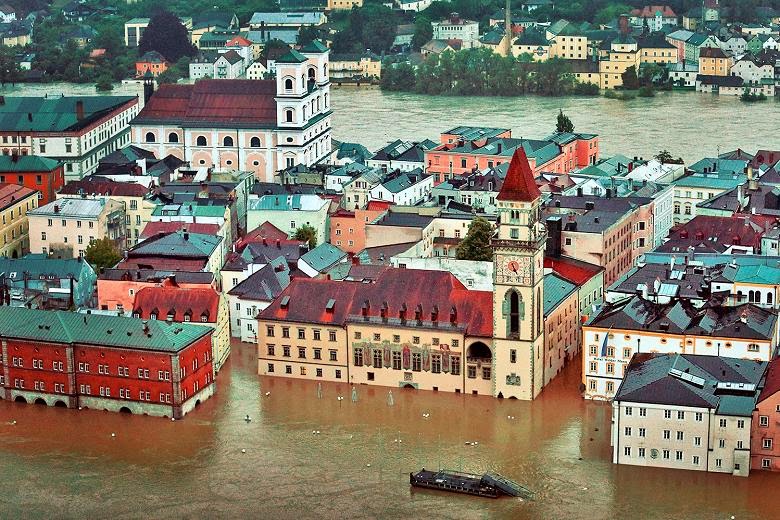
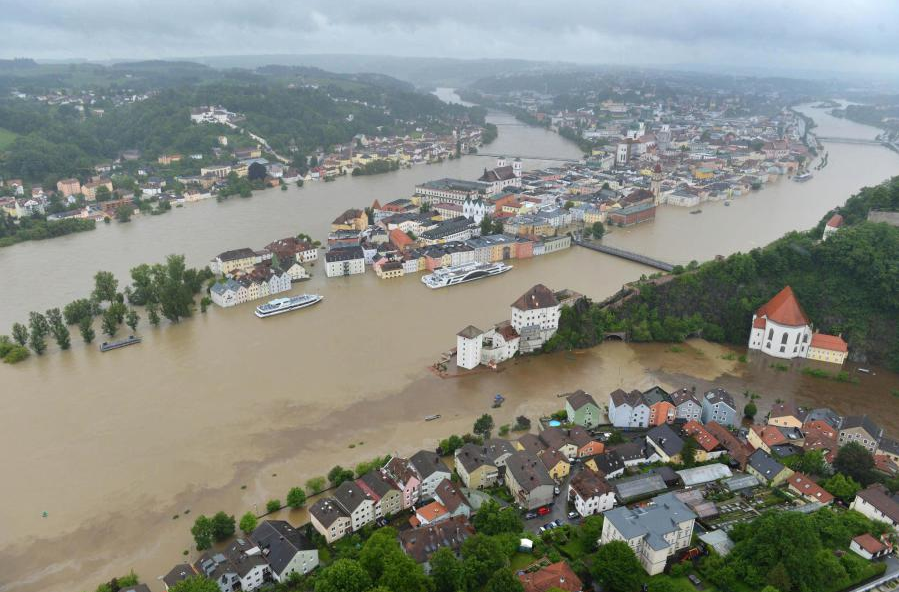
Passau was established on the confluence of three rivers; the largest and most well known is the Danube, the other two are the Inn River and the Ilz River. The downside to this natural aquatic beauty is the propensity to flood. As a matter of fact, in June 2013, they experienced the worst flooding in 500 years. One of the buildings next to the river has painted markings documenting the floods. What is hard to see in the photo is the most recent flood is pencilled in, not painted on the building yet; so I added that with Fotor. (Flooding pics are from the internet, since I was not there at the time; otherwise all pics from this post are from my iPhone. I do not own these pics and if the owner reads this and objects to my using them, I will remove them).


I had the great pleasure of meeting two of my distant cousins who live in Passau. A third generation American, my German connections have long been lost, and it is only by the magic of the Internet and Facebook that I have been able to reconnect with quiet a few of my German relatives. Martina and Florian are fun, intelligent, warm and exceptionally hospitable. Meeting them was phenomenal, and I am blessed to count them as friends and relatives. We had coffee and pie at the Konditerei Simon. After that, we had a great walking tour of the city, and my Bavarian cousins, both Passau natives gave me a city ... isn't that about the coolest thing in the world? How often in life do you get a personal tour of a foreign city by cousins you just met for the first time?  I have to say, this must surely be one of the highlights of my life.  I do look forward to the day when I can show them around Chicago.  After our walking tour, we ended the visit with coffee and a glass of wine at a amazingly charming cafe. We sat in the outside portion, in a courtyard in the center of the restaurant. We were surrounded by trellises with hanging plants. It was a cool fall evening in October, the air was fresh, the architecture surrounding us medieval Bavarian. The restaurant had thick fuzzy blankets to wrap up in while you enjoyed your hot beverage in the cool autumn air. 

 
This is the Kondieterie Simon, where I met my cousins


The city of Passau was breathtaking. It was never a surprise when I looked at a building and Martina would say “this was built in the 1200’s.” Amazing and awe-inspiring, but not a surprise. The centuries old building had a certain look and feeling to them, as if they have an aura themselves, speaking their own language about the centuries they have seen. The streets in the old part of town were cobblestoned and narrow, and overflowing with pedestrians. There were also many street vendors, entertainers and bicyclists. I saw people selling hot chestnuts, playing the French Horn, and putting on marionette shows. 


One of the things that I found particularly amusing on my Bavarian tour, is that there is an Irish pub every town. Being half Irish and half German, I found particular personal delight in this. Who doesn't like an Irish pub, after all? Us Irish are loads of fun ... and so are we Bavarians. Considering the two halves of my heritage, its no wonder I seldom take life too seriously. Particular amusing to me was this Irish Pub in Passau, right next to a lederhosen shop. I could buy my lederhosen and go right next door for a Guinness, and celebrate the totality of my heritage in one fell swoop. 


I could go back every year to Bavaria, and in particular, Passau. I hope to return with family and loved ones to share the experience.